

















Keeping carbon in nature
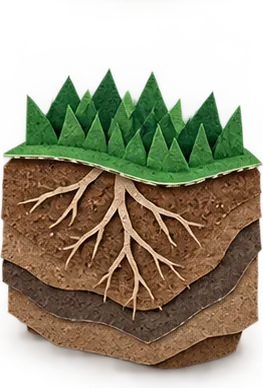
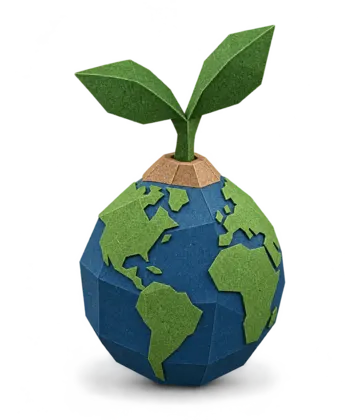
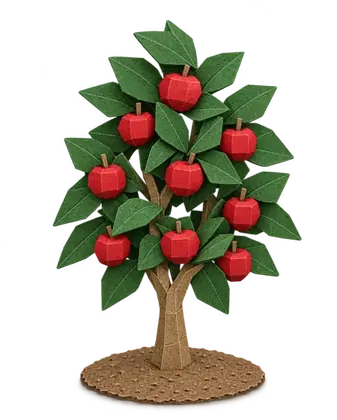
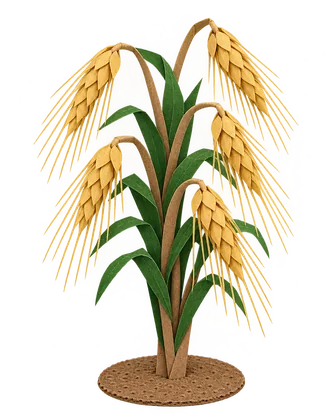
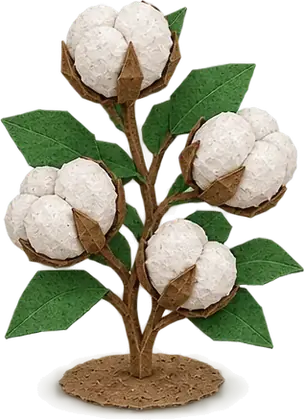
Plants take in CO₂ through photosynthesis. Some of that carbon stays in vegetation and soil; fires, respiration and decay can release it back into the air.
Source: NASA, the carbon cycle
Carbon credits, done honestly
Carbomint connects the people who care for the land — farmers and foresters — with companies that want to give back the carbon they’ve emitted. Real climate work. Fair income. Plain-language contracts.
Connected nature
Soil, water, air, forests and animals make up the landscape that inspires Carbomint. Our work brings together responsible carbon-credit solutions, environmental and operational consulting, and digital products.

Looking after vegetation helps keep carbon, soil, water and habitats. See how, with sources.
Plants take in CO₂ through photosynthesis. Some of that carbon stays in vegetation and soil; fires, respiration and decay can release it back into the air.
Source: NASA, the carbon cycle
Standing vegetation helps hold soil in place against erosion and regulates the water that feeds springs and rivers. How much depends on the ecosystem and how the land is managed.
Source: FAO, soil and water
Conserved and restored areas can shelter plants and wildlife and keep up the ecosystem services that people and farming rely on too.
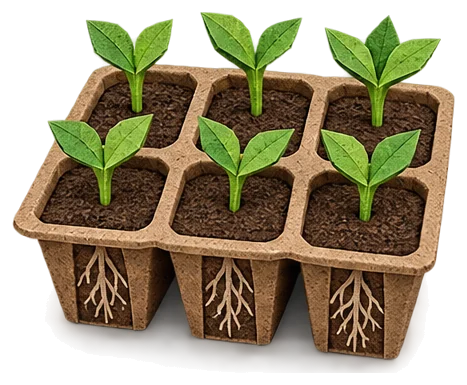
That cycle of care is what we want to help strengthen: bringing people together, structuring projects and working towards the conditions to conserve and restore over time.
O₂ is part of photosynthesis, not a way of offsetting pollution. Each project’s benefits have to be demonstrated with their own indicators; this section does not report any impact already achieved by Carbomint.
In one sentence
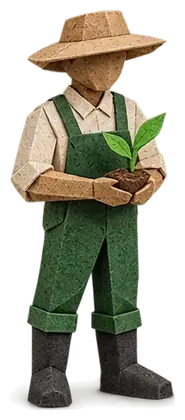
One end
Farmers and foresters keep the land greener and greener. The land stays theirs; the climate result is measured.

In the middle
Carbomint organises the project. An independent verifier checks the numbers, and the credit gets a public registry entry: anyone — partner, buyer, journalist — can look it up.
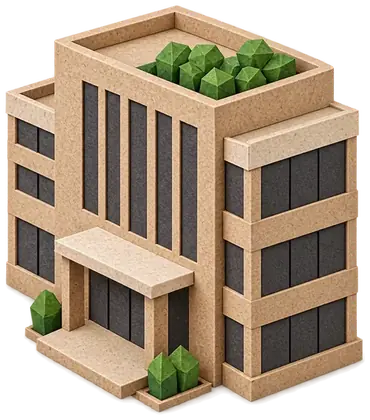
The other end
It wants to give back the carbon it emitted. It buys the credit knowing where it comes from; once used, the credit is taken out of circulation.
The money travels the other way: from the company to the people doing the work on the land, with the split set out clearly in the contract.
Our name
Giving value to climate action.
Carbomint brings two ideas together. “Carbo” stands for carbon, while “mint” comes from the verb “to mint”: to make coins.
For us, minting is a metaphor for making value tangible. Our name expresses a conviction: actions that genuinely help the climate deserve economic recognition. It connects care for the climate with the value of the work behind it and the people who make that work possible.
Definition of “to mint”: Oxford Learner’s Dictionaries
Carbo: carbon. Mint: to make coins.
In short: carbon gives the name its focus. Minting gives it its meaning: recognising the economic value of climate action.
Before anything else
We start with the total area and how it’s split today. Each part has a different story — and that’s where the origin of any credit begins, for whoever owns the land and whoever buys.

Area used for growing crops.
Area used for raising livestock.
A stretch where the soil or vegetation needs to recover.
Area kept under native vegetation.
Dashed line: illustrative property boundary
Every part needs analysis. None of these areas generates credits automatically.
Illustrative diagram, not to scale and without percentages. It doesn’t represent a real property.
How it works
A carbon credit represents one tonne of CO₂ equivalent retained, reduced or removed, following a methodology with measurement, reporting and verification. That’s why the path has six steps, from the land to the buying company — and none can be skipped. Each step shows where it happens.
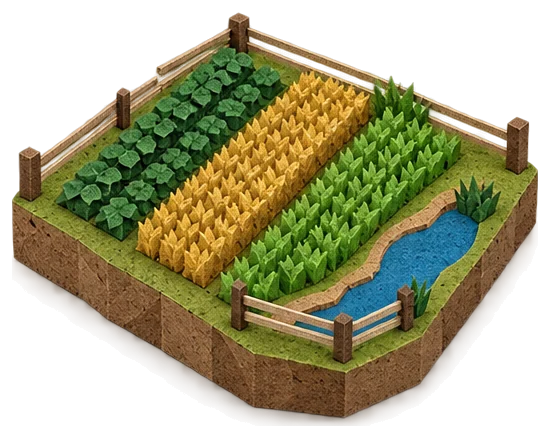 1On the farm
Location, land use, history and the documents available — such as the land title and, in Brazil, the CAR rural environmental registry — show whether a project is worth studying.
 2Farm + Carbomint
Activities, measurement, costs, revenue sharing and exit rules are put in writing. The project goes through the validation and registration the programme requires.
 3On the farm
The agreed practices happen on the farm. Field records and imagery show what changed over the period.
4Independent verificationAn independent team checks the results. Issuance depends on the programme’s rules and approval — not on the signed contract.
5With the companyAfter issuance, the buying company receives the credit with its origin, documents and registry number. For the landowner, an issued credit isn’t money in the bank yet.
 6Back to the farm
Once a sale is made and paid, the payout follows the order set in the contract, with clear accounts. The area keeps being monitored.
When the company uses the credit to offset emissions, it’s retired in the registry, in the company’s name, and can’t be used again. If a new period brings eligible results, they go through measurement, verification and issuance all over again.
Reference flow: Verra, Verified Carbon Standard
Nothing is automatic. Having forest, cattle or crops doesn’t generate credits by itself: it takes a project activity, a recognised methodology and independent verification.
 Digital tools, in service of the project. We’re developing tools to organise each area’s map, records and monitoring. They support the carbon project — they don’t replace fieldwork or verification — and they aren’t in operation yet.
Who certifies
Carbomint does not certify credits or approve its own numbers. Trust comes from separate roles, each with its own rules and oversight.
The rules
It sets the rules and methodologies, approves auditors and keeps the public registry where each credit gets a serial number. International examples: Verra (VCS) and Gold Standard, mentioned only as examples, with no link to Carbomint. In Brazil, the SBCE will accredit methodologies for the regulated market.

The audit
A validation and verification body checks the project before registration (validation) and the results afterwards (verification). It must be approved by the programme and accredited, for example, to ISO 14065.
The oversight
Internationally recognised accreditation bodies assess auditors, and the programme can suspend them. The ICVCM, the international integrity council for the voluntary market, assesses whether programmes require robust independent verification.
Tap a name to see what it is, in plain language. Links open the official websites in a new tab.
A non-profit that runs the Verified Carbon Standard (VCS), the most widely used carbon credit programme in the world. It sets rules, approves methodologies and keeps a public registry. Mentioned only as an example, with no link to Carbomint. Verra official website ↗
A non-profit based in Geneva, Switzerland. It runs a standard that measures the impact of climate and sustainable development projects and can issue carbon credits. Mentioned only as an example, with no link to Carbomint. Gold Standard official website ↗
Brazil’s Greenhouse Gas Emissions Trading System, created by Law 15.042/2024. It is Brazil’s regulated carbon market, with emission caps for some sectors, and is still being set up. Read the article of the law
This is the independent audit. Before registration, it checks that the project follows the methodology (validation); afterwards, it checks the measured results (verification). It must be approved by the programme and cannot be the project developer. How Verra describes this role ↗
An international standard with the principles and requirements for bodies that validate and verify environmental information, such as greenhouse gas emissions and removals. Being accredited to it means being assessed by a third party. ISO 14065 official page ↗
Organisations that check whether auditors meet standards such as ISO 14065 and grant accreditation. In Brazil, this is done by Cgcre, part of Inmetro, which accredits greenhouse gas validation and verification bodies. Accreditation on the Inmetro website ↗
Integrity Council for the Voluntary Carbon Market: an independent non-profit council that set the ten Core Carbon Principles, a global quality benchmark. Approved programmes and credit types can use the CCP label. ICVCM official website ↗
Why so many steps? Whoever develops the project and whoever sells the credit have a stake in the result. Separating who measures, who checks and who issues reduces conflicts of interest and lets anyone look up where a credit comes from.
In Brazil: Law 15.042/2024 requires credits accepted in the SBCE to be verified by an independent entity, under an accredited methodology, and entered in the Central Registry.
Sources: Verra, validation and verification · ICVCM, Core Carbon Principles · Brazilian Law 15.042/2024, art. 44
What we stand for
What guides our work. These are aspirations and principles, not results already achieved.
Vision
A future where healthier ecosystems, cleaner air and resilient businesses thrive together, supported by responsible innovation.
Mission
To connect landowners, businesses and expertise through responsible carbon-credit solutions, environmental and operational consulting, and digital products, turning complex challenges into practical progress and lasting value for people and the planet.

We build trust through evidence, transparency and clear commitments. We distinguish ambition from results and make uncertainty visible.
We respect forests, farmland, biodiversity and natural resources. We consider the lasting consequences of our choices, not only short-term gains.
We connect landowners, producers, businesses and specialists. We value local knowledge, respect ownership and seek fair, transparent relationships.
We design technology around real people and real needs. Across sectors, useful solutions matter more than complexity for its own sake.
We turn complexity into clear priorities, accountable actions and meaningful measures. We learn from outcomes and improve what comes next.
We consider the people and environments affected by our work. We take responsibility for our decisions and seek lasting value beyond a single transaction.
Frequently asked questions
It is a unit representing one tonne of CO₂ equivalent kept, reduced or removed, following a methodology with measurement, reporting and verification. The credit is not the tree: it is the measured result.
No. Carbomint organises the project. An independent verifier checks the results, and issuance depends on the programme’s rules and approval. Carbomint is not a certifier.
Not on its own. It takes a project activity, a recognised methodology and independent verification. Every area needs to be assessed.
No. The land stays with whoever owns it. What is put in writing are the activities, measurement, costs, revenue sharing and exit rules.
Only after issuance, sale and payment. An issued credit is not yet money received; payouts follow the order set in the contract, with clear accounts.
When a company uses a credit to offset emissions, it is retired in the registry in that company’s name and cannot be used again.
No. We also offer environmental and operational consulting for businesses. You will find the details in the consulting section.
Now, your part
Choose your path. Each section explains in detail what changes for you, with steps, roles and common questions.
I have land, pasture, crops or forest
How your land can be assessed for a carbon project — no promises before the analysis.
Go to my section →I want to buy credits with care
Origin, evidence, risks and what your company can claim on solid ground.
Go to my section →Need environmental and ESG support for your business? Discover our consulting. Press or another question? Get in touch.
Get in touch
Whether you have land for a partnership, carbon to offset or a question for our team, we’d love to hear from you.