
For companies
Before you buy credits, understand what you’re buying.
A carbon credit is the end of a story: a piece of land, an activity, measurements, verification and a registry entry. We help your company see that story before deciding — and tell it on solid ground afterwards.
The credit’s path
From the land to your report, in four handovers.
It’s the same full cycle shown on the home page, seen from the buyer’s side. Each handover leaves a trail your company can check.
 1
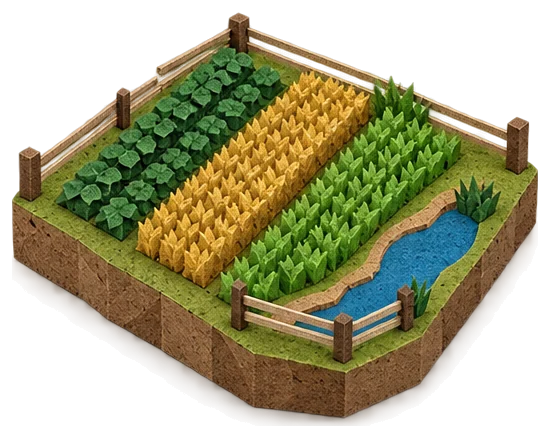
On the land
A farmer changes how the land is managed, restores it or conserves an area. The project defines what will be measured.
 2
Measured and verified
Measurements in the field and from imagery. An independent verifier checks the numbers.
 3
Issued and registered
Each credit gets its own serial number in a public registry, linked to the project it came from.
 4
Used by the company
When it offsets emissions, the credit is retired in your company’s name and can’t be used again.
1 credit = 1 tonne of CO₂ equivalent retained, reduced or removed, following a methodology with measurement, reporting and verification. Source: Brazilian Law 15.042/2024, art. 2
The origin
First, we look at the whole farm.
We start with the total area and how it’s split today. Each part has a different story — and that’s where the origin of any credit begins, for whoever owns the land and whoever buys.
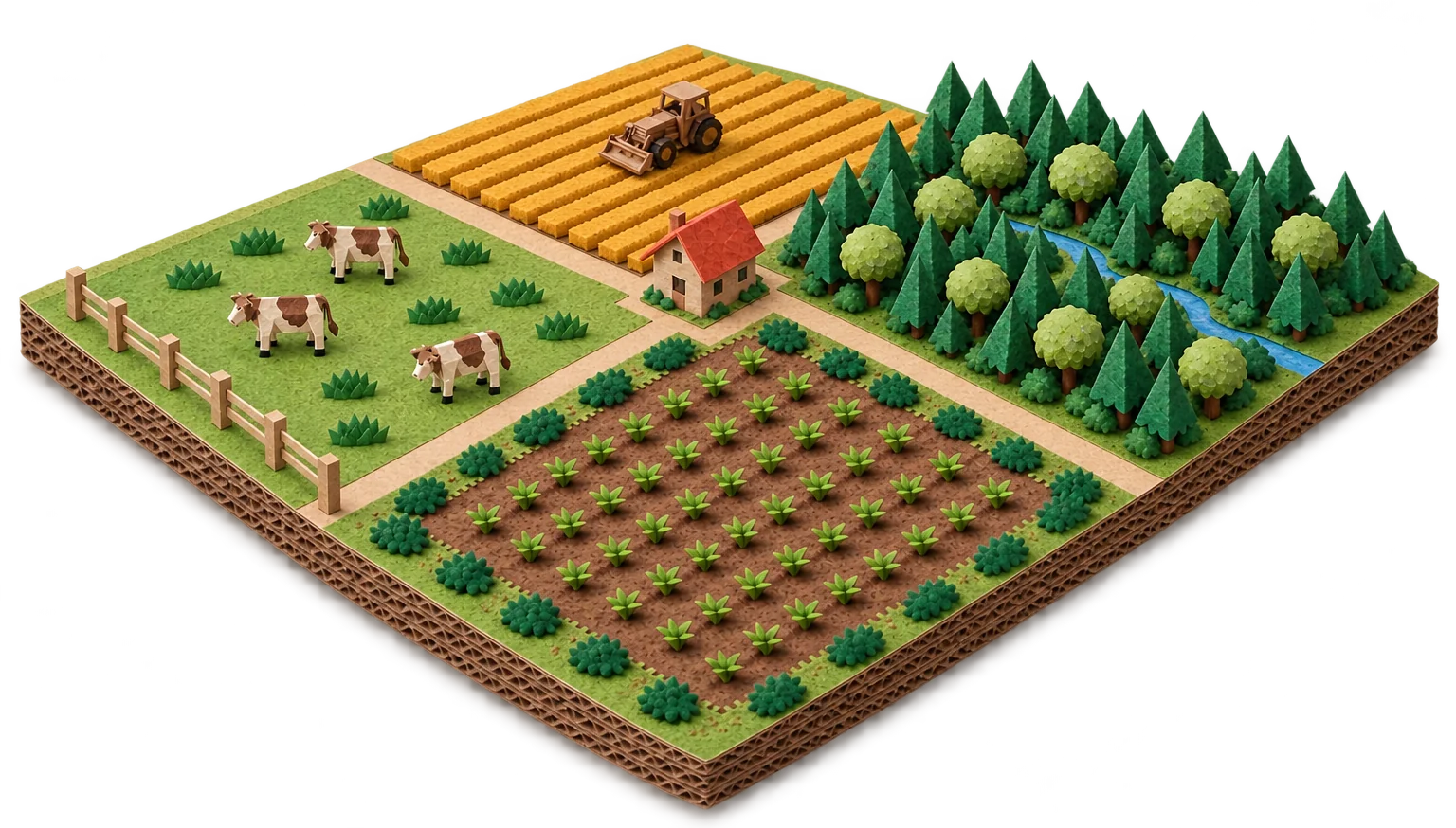
- 1
Cropland
Area used for growing crops.
- 2
Pasture
Area used for raising livestock.
- 3
Recovering
A stretch where the soil or vegetation needs to recover.
- 4
Preserved vegetation
Area kept under native vegetation.
Dashed line: illustrative property boundary
Every part needs analysis. None of these areas generates credits automatically.
Illustrative diagram, not to scale and without percentages. It doesn’t represent a real property.
Questions we answer with you
Six questions before you sign.
Where does it come from?
Where the project is, who holds the rights to the land and who the people involved are.
What does the project do?
Restoration, conservation or a change in land management: which activity produces the result, and why it wouldn’t happen without the project.
What’s the evidence?
The methodology used, measurements, verification reports and the public documents available.
Has it been issued and registered?
The difference between an issued credit, a future credit and a mere estimate. Each carries a different risk.
What are the risks?
Permanence, fire, land disputes, reputation — and what happens if something goes wrong.
What can we claim?
How to talk about the purchase on solid ground, without promising neutrality or benefits the documents don’t support.
Credit types
Not everything called a “credit” is the same thing.
Before comparing prices, compare the stage. It changes the risk, the timing and what your company can say.
Issued credit
Already verified, with a serial number in the registry. It can be used (retired) to offset emissions.
Future credit
Advance purchase of credits that have yet to be generated and verified. It helps get projects off the ground, but may be delayed or never materialise.
Estimate
A calculation of what a project might generate. Useful for planning, never for claiming results.
How we work with your company
From goal to communication, no shortcuts.
 1
Goal
What your company wants to offset, why, by when and for which audience.
 2
Criteria
Project type, region, credit stage and the minimum documents required.
 3
Origin and documents
We present where the credits come from, with documents, risks and what is still to be confirmed.
 4
Decision and message
A clear contract and a review of what the company will communicate, before it goes public.
ESG and procurement
Clear criteria for decisions that need to be accounted for.
We organise information, criteria and responsibilities so that procurement, reporting and communication tell the same story.
- Criteria for selecting projects and suppliers
- Organising documents and evidence
- Reviewing environmental claims before publication
- Benefits beyond carbon — soil, water and habitats — handled with their own indicators, never automatically attributed to the credit
What we don’t do
- Sell a generic “sustainable company” badge
- Treat an estimate as a verified result
- Promise neutrality without documentary backing
Frequently asked questions
What companies usually ask.
Does buying credits make my company “carbon neutral”?
Not on its own. Credits offset emissions the company couldn’t avoid. A neutrality claim requires an emissions inventory, real reduction efforts and documents to back it up. We help you choose words the documents can support.
How do I know the credit wasn’t sold twice?
Every issued credit has its own serial number in the programme’s registry. When your company uses it, it’s retired in your name — and that record can be checked.
What’s the difference between the voluntary and the regulated market in Brazil?
Law 15.042/2024 created the Brazilian Emissions Trading System (SBCE), the regulated market. The voluntary market still exists for companies that offset by their own choice. Each has different rules, so it’s worth checking which one your purchase falls under.
Source: Brazilian Law 15.042/2024
Is it worth buying future credits?
It can be, if the company understands the risk: the credit doesn’t exist yet and depends on the project being carried out and verified. The contract should say what happens if delivery is late or doesn’t materialise.
How much does a credit cost?
It depends on the project type, stage, volume and market. We don’t publish a price list: each proposal shows origin, stage and terms, so the comparison is fair.
Weighing up a credit purchase?
Tell us your company’s goal and decision timeline. We’ll point out what to check first.